I'm over 65 and my government has decreed I should stay at home as long as the corona virus is spreading in California. The exception is that I may go outside as long as I stay at least six feet from anyone else. I'm also allowed to garden at home. I took full advantage of that today.
I went for a short walk to the mailbox and then took the same walk again with my camera. That's when I took all the photos. I took several shots of the plants in bloom along the way, but the shot I liked best was the one you see at the top. All the rain made this branch a garden of lichens and Spanish moss. I don't remember any other year it hosted so many other plants.
We had sunshine for the first time since the weekend. The clouds were like cotton in the blue sky. I didn't realize how serious a case of cabin fever I had until I spent time enjoying the outdoors today.
In two days it will be spring. My garden is filling with volunteer seedlings. In the photo below the borage seedlings are easy to spot, but the lacy nigella seedlings are hiding under the borage leaves and are barely visible. If you click on that large borage seedling in the middle to expand the photo you will see it's already preparing to bloom.
As you can also see above, the the weeds are beginning to grow tall enough to pull. I filled the composting bin with dead branches I pruned and weeds I pulled today.
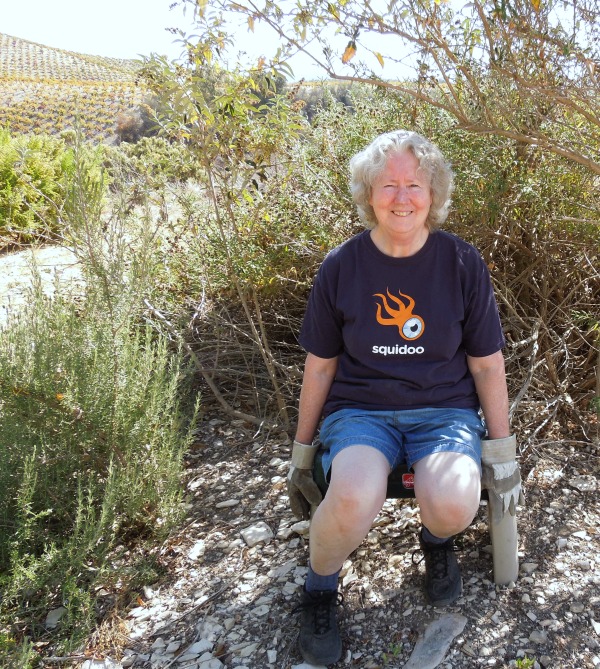
It's theme day for City Daily Photo bloggers again. The theme this month is "Me." So how does one define oneself in a photo? I don't really do selfies except as shadow photos. The photo I like best of myself is this one my husband took of me at my request. I was about to write an article for Squidoo (now gone) to review my garden kneeler, on which I'm sitting.
I love being in a garden. I love working in the garden as the birds sing and keep an eye on me from a fence or from a nearby tree.
I love getting my hands in the soil and helping things grow. And I like doing these things in the solitude of the wine country around me. I love looking across my fence on three sides to see my neighbors' vineyards. I like the fresh air and the quiet broken mostly by birdsong. These are the things that make me feel most alive.
Yet the shirt is also me. It represents the hours of my life I've spent in front of my computer writing. After Squidoo was sold to HubPages, I left some of my best work there, especially the articles inspired by my time in the garden. You can see those articles and those on other topics about the things I love on my HubPages profile.
I now do most writing on my own blogs. This one is my fun blog. It's where I relax and share my photos of the places and nature I love so much. I share more of my gardening moments at Barb's Garden Observations.
This Is Also Me
The photo below is one of the shadow selfies. It shows me photographing my world. If I'm not in the garden or at the computer or doing chores, you will probably find me outside taking pictures. In this photo I was documenting a major event in Paso Robles. It was raining!
I'm looking forward to see what the other City Daily Photo bloggers have posted to present themselves to the world. You can see their photos here.
If you have followed my last two posts, you know that I went for a photo walk on Wednesday and lost all but five of my 71 photos I took on my block. Seems I had a bad SanDisk. I was fortunate that all the photos were within quick walking distance and could be reshot. The plan today was to replace the shots I lost.
Off I went with my camera. It was a beautiful day. Wednesday had been dark and overcast. One of the shots I had planned to reshoot was this pomegranate tree. I loved the sign at the bottom.
I Left with Just a Camera and Came Back with Much More Than Photos
Today as I walked by the tree I noticed someone was there, but it appeared to be a workman. I thought I'd ask anyway if the tree was his. He said it belonged to the homeowner, but he was authorized to let me have some fruit. He picked two lovely pomegranates for me and I brought them home. Aren't they beautiful? The man who picked them for me told me they were ripe when they cracked. I never would have known that.
A Chat with the Neighbor Who Owns the Other Pomegranate Tree
I found Judy back in her front yard today, and stopped to chat and take pictures of her garden. I had noticed on Wednesday that all the pomegranates had been picked, so I figured she was planning to use them. That's one reason I'm so glad the other neighbor shared. As we were talking, the neighborhood cat came up to us. I mentioned him in What's Going on in Kitty's Mind a couple of weeks ago. He was a bit friendlier this time. I found out his name is Mack and that the neighbors want to fatten him up because he had been sick and not eaten. I didn't realize until I unloaded my photos that while I was trying to photograph him, Judy and I were both in the photo with him -- in shadow form.
We actually did chat about more than the cat. We talked about her plants and I found out the names of some of them I didn't know. Then she told me she had just dug out some bulbs she didn't want and offered them to me. She thinks they are daffodils. I can always use more of those, but it means I'll have to start working in my garden again. I really need to do that.
I didn't have anything but my pocket to carry the bulbs in, but I stuffed them in my pocket. Then I put them in this strawberry basket so you could see my gift.
It always amazes me how something as beautiful as a daffodil begins like this.
A Final Gift
This last gift was one only God could provide. There was quite a sky show as I was returning home after my walk. There were a lot of contrails going in different directions. Here's a photo.
Now let's watch the contrails as they are made. Pretend you aren't in a hurry and spend this minute and a half watching jets you can't see making contrails you can see. You can even still see them when they are partly into the cloud.
The sky show was an added blessing and I would not have seen it had it not been for another inconvenience. After I'd talked to Judy and had a pocket full of bulbs, I shot a few more pictures on the way back home. As I was almost back to the pomegranate tree, which was to be my most important shot, my camera battery died. I had to go home and charge it. So I put it on the charger and fixed dinner and ate while it charged. It had charged enough to shoot again by the time I finished eating and the sun was beginning to go down.
I went back to the pomegranate tree and got my final tangible gift. Then the sky show started and I shot as much of it as I could. So I guess it was also a blessing that my camera battery died when it did or I would not have been outside for the sky show.
All in all, it's been a day of blessing. Have you had days when inconveniences were blessings in disguise?
Many parts of the birch tree are edible for humans. These include the bark, the leaves, the buds, and the sap. However, edible does not necessarily mean tasty. The author of "Edible Birch, Chaga" shares the results she got when making tea, birch syrup, and just eating various parts. Most writers agree the fruits make good food for the birds.
The book Feasting Free on Wild Edibles by Bradford Angier explains how to make birch tea and birch syrup, as well as many other survival foods you can make from plants found in the wild.
The graceful birch trees easily lend themselves to artistic photos and designs. Their bark is unique, especially the white birches with bark that peels like paper. The tree also can have a weeping appearance, especially when fruiting. You can see that in the photo above and in the final photo in this post. The birch tree inspired the creation of these throw and lumbar pillows on Zazzle.
Birch trees have medicinal uses. American Indians use the tea to relieve headaches. Some tribes roasted the fruiting cones over campfire coals and breathed the smoke to relieve nasal congestion. These are just a couple of the medicinal uses for birch I found in Rodale's Illustrated Encyclopedia of Herbs, my go-to book for everything herbal. One can also make a hot poultice of the leaves, bark, and fruits to apply to the skin.
The skin will absorb the methyl salicylate in the birch parts to help skin irritations and minor wounds. Such a poultice may also be used to ease arthritis pain. None of these remedies have been tested by today's researchers for effectiveness, but some modern remedies for muscle pain do contain some methyl salicylate combined with menthol.
We know the American Indians made canoes of the birch's waterproof bark. An oil extracted from the bark was used as a glue when making arrows. You, too, can make beautiful and useful objects from birch. Some suggestions are star ornaments, baskets, rings, woven mats, and shoes. The book below will show you how to make these and many other things from birch you can use.
I'm glad I have a birch tree in my yard. Maybe one day soon I'll make better use of it. I'm glad I have survival food if necessary, along with a possible way to relieve pain. I'll leave crafts to those who enjoy them. I'd rather take photos and write when I want to be creative.
Do you have a birch tree in your yard? Have you ever used it for anything except the joy you get from seeing it every day?
My Reality Has to Go Beyond What I Can See on my Computer Screen
Sometimes when I have a lot of writing to get done, it's hard to remember a world beyond my office. Yes, my husband interrupts to ask me to find things or do computer tasks for him. The phone rings and sometimes I have to answer it. But when I'm alone in the house and no one enters my office door but me, it's easy to forget there is a world outside the house when I'm working inside.
Most of the day I'm happy to have the time for productive work. But when late afternoon rolls around, I get antsy. I look outside my office window and see the tree above. Something happens inside me that almost catapults me out the door. Maybe it's the knowledge that a gorgeous sunset is on the way and I need to photograph it.
Maybe it's hearing the train whistle and knowing it will soon be roaring on the other side of the river overlooking the park. Of course I need to take a picture.
Sometimes I take to the garden and pull a few weeds, prune, or deadhead a few flowers just to get out into the world beyond my walls. Sometimes I even discover something new that God planted, like these seedlings nestled among the weeds, behind the Lamb's Ears. I believe they are either borage or mullein, but I won't know for a while. They may even be clary sage. They all resemble each other at this stage. When I know for sure I'll know what to do with them. What I do know is that they aren't weeds.
I can do most of these activities without leaving my yard. All of them help me ground myself and connect to my Creator and the world around me.
When I'm Especially Restless I Need to Go Farther
That usually means I take a photo walk in Larry Moore Park like I did Saturday. I usually take these walks in late afternoon or early evening before dark. That's when I feel like I will jump out of my skin if I don't go somewhere outside.
This is a scene from my Saturday walk. Unfortunately, it was too dark to capture a photo of the bunny ahead of me on the trail. I came home from that walk better able to relax and get a good night's sleep.
Another easy walk is the Charolais Corridor Trail. I get a new perspective every time I walk the trail, depending on the season, the time of day, and who else is on the trail. I've been walking this trail since it opened a few years ago. This photo of the east entrance was taken on January 30, 2013 when the trail was still almost new. The trail begins on South River Road and ends on the western side across from the entrance to Larry Moore Park and the Salinas River Trail.
Sometimes it's the practical matters that make me leave my office -- those pesky doctor appointments, labs tests, or errands. I often choose the early evening to shop. That's what I did tonight to get out. These appointments and errands aren't as much fun as photo walks, but I can still find nature in the landscaping, and the sky is always above as I walk to and from my car and wherever I'm going.
A Dose of Nature Usually Settles My Restlessness
Those sunsets I see between my trees every night help a lot. The sky always helps me remember how big my universe it and how powerful the One who controls it. I feel much less confined after a healthy dose of sky. And I can see sky anywhere I go outside.
Where do you go when you get cabin fever and need to get out of the house?
The City Daily Photo Bloggers theme for October is "Abandoned." We can abandon almost anything. I wrote on this theme in May 2015 and featured many of our abandoned buildings. See "N" is for Neglected and Abandoned Buildings. I had to come up with something new for this post, so I've decided to show you my abandoned gardens in Templeton.
Photos of My Abandoned Gardens
In the photo below, you see what's left of an herb garden I planted about twenty years ago on a slope behind the house.
Abandoned Herb Garden on Slope
Nature has a way of taking over when a caring gardener is no longer active. I had to abandon my gardens here after some major surgeries. Someone clears the weeds from around the edges during fire season, but there are still plenty hidden among the herbs. Most of what you see here are three varieties of sage left to do what they will. There are a few irises and they still bloom. Hidden from view are the santolina and lavender, which still hold their own. The oregano has almost been smothered by the sages, but manages to get its head into the sun enough to live. The rosemary has also survived.
Perennial herbs are hardy. These plants have survived over a year with no irrigation. Of course when a flower bed with no perennial plants is abandoned, it will look like the one below. There may still be some rhubarb here if the drought didn't finally kill it, and some lemon balm may remain alive under the weeds. Now its mostly wild grasses, sow thistle, and mallows in season.
Sometimes nature presents us with unexpected gifts, like this lupine flower that sprang up in the midst of the weeds on the slope. I actually planted lupine years ago, but it seemed to disappear. Some years it comes up and some years it doesn't.
Here's yet another view of the abandoned herb garden on the slope. This shows you the lavender that was hidden in the other photo. It's only March in these photos, so lavender isn't blooming yet. That bit of yellow near the left is a calendula -- the flower that keeps reproducing no matter what. See How Colorful Calendula Brightens My Garden All Year Long.
Umbrage is abundant in the North County. You probably see it everywhere you go. Umbrage is simply the foliage of our many trees and shrubs which produce shade. We depend upon it most in the summer when we seek shelter from the hot sun. The people in the photo below, taken at Leffingwell Landing in Cambria, are taking advantage of it.
You Need to Choose and Place Shade Trees Carefully
Sometimes umbrage helps cool a home in summer when you have trees near your house. These trees are helping to shade a mobile home on our Templeton property, or were. One of those large pines fell since I took this photo and we are lucky it didn't fall on the mobile home. You have to be careful about choosing and maintaining trees that provide shade on your property.
Sometimes umbrage is a nuisance. When my mother planted this tree behind her new rose garden, she thought it was an apricot tree. Maybe it is, but it has never produced so much as a blossom. What it does produce is umbrage -- lots of it. The shade makes it much harder for the roses near and under it to get the sun they need. Can you even see that small pink rose near the middle of the photo that the shade makes barely visible?
If you have the opposite problem and need to plant shade trees on your property to help cool your home or patio, one of these books will help you make the right choices -- trees that won't clog your plumbing or be prone to falling on your home.
If you enjoyed this post, please share it. The sharing buttons are just above the comment box at the end of this post. The photo below is especially designed for pinning.
This is my twenty-first post for the 2016 AtoZchallenge, a Blogging Challenge for the month of April, 2016. My theme is Things You Can See or Experience in North San Luis Obispo County. Here are links to the other posts if you missed them.
I love lupine. I used to have a lot of it on my Templeton property. The drought killed most of it up on the hill when there was no rain. The seeds I planted in my herb garden rarely grew. It's been years since lupine was there, even though the seeds for it have been in the ground. Today I went home, and although the property, including the herb garden was overrun with weeds, I saw lupine finally blooming again. I love surprises like that.
Here's a closer look at the photo above.
Lupine supposedly is a perennial plant, though I always considered this form of it annual. I've seen a shrub form in Cambria at Moonstone beach that I'm sure was perennial because it's always there. There are at least 82 species of lupine in California. All species are related to the pea, but the seeds are toxic. The plant's name Lupinus spp. means "wolf" because it was thought that lupine depleted nutrients from the soil. Instead, though, like other legumes, their root nodules add nitrogen to the soil that it needs.
The photo to the right shows a bit more of the overgrown garden on a slope. Behind the lupine, to the left of the title, is an overgrown clump of thyme I need to harvest and dry. It's already blooming, but it's flowers are too tiny to see in this photo. The lupine chose to emerge among the irises that have not bloomed yet. The large lavender, oregano, and sage plants are out of sight in this photo.
The lupine plants you see here came from seeds I collected one day from a vacant lot in San Luis Obispo while I was on a walk. The pods were ready to explode, and the timing was perfect. They have bloomed a couple of times before in wet years, and it's a joy to have them back this year.