I'm over 65 and my government has decreed I should stay at home as long as the corona virus is spreading in California. The exception is that I may go outside as long as I stay at least six feet from anyone else. I'm also allowed to garden at home. I took full advantage of that today.
I went for a short walk to the mailbox and then took the same walk again with my camera. That's when I took all the photos. I took several shots of the plants in bloom along the way, but the shot I liked best was the one you see at the top. All the rain made this branch a garden of lichens and Spanish moss. I don't remember any other year it hosted so many other plants.
We had sunshine for the first time since the weekend. The clouds were like cotton in the blue sky. I didn't realize how serious a case of cabin fever I had until I spent time enjoying the outdoors today.
In two days it will be spring. My garden is filling with volunteer seedlings. In the photo below the borage seedlings are easy to spot, but the lacy nigella seedlings are hiding under the borage leaves and are barely visible. If you click on that large borage seedling in the middle to expand the photo you will see it's already preparing to bloom.
As you can also see above, the the weeds are beginning to grow tall enough to pull. I filled the composting bin with dead branches I pruned and weeds I pulled today.
It seems just yesterday my Lamb's Ears were only inches high. Then the flower spikes began to grow. Now the small flowers are in full bloom and the bees love them. You can see one foraging bee in the bottom left in the photo below. You may also spot a couple of blurry ones. Bees don't stay still very long. And if one is still, several others are in the air or about to be.
If you've ever tried to photograph bees, you know they like to move to a different flower as soon as you get them in focus. When my herbs are in bloom, each seems like an airport. I decided to make a brief video to capture a few seconds of the bees moving around on this clump of Lamb's Ears . You can see how fast they are and how quickly they move from flower to flower. Unfortunately they also insisted on flying into the shadow and out.
Playing with a Bee Photo
I did manage to get one bee to stay still and visible for long enough to get a decent shot. I played around with a focus effect to blur the background and make the bee easy to see. Bees not only move all the time, but they also hide. Sometimes all you will see is the head or the stinger end.
Another reason I used the focus effect was to blur the rhubarb chard plant that was bolting. I liked its colors, but it was looking the worse for wear and it would have been a distraction. Leaving all the details in the chard would also have made the text on this photo harder to see.
Some insects are fairly easy to photograph, but not the bee. Ladybugs are pretty cooperative. So is the praying mantis. They don't exactly pose, but neither do they keep moving most of the time. Here are some of the photos I got of them and put on Zazzle products.
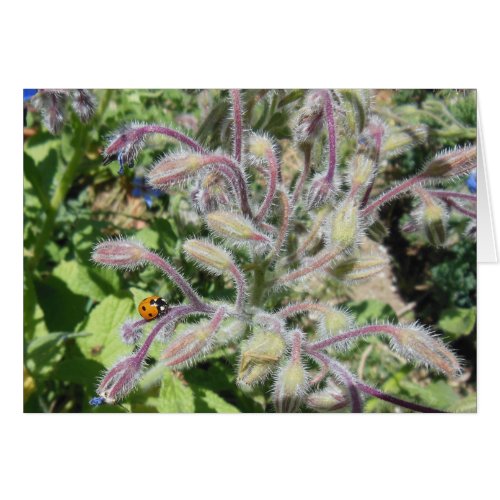
You will notice that they are all on herbs. The Praying Mantis is on mullein. The ladybug is on borage. And I did capture that one bee on the Spanish lavender for my jigsaw puzzle.
The City Daily Photo Bloggers theme for October is "Abandoned." We can abandon almost anything. I wrote on this theme in May 2015 and featured many of our abandoned buildings. See "N" is for Neglected and Abandoned Buildings. I had to come up with something new for this post, so I've decided to show you my abandoned gardens in Templeton.
Photos of My Abandoned Gardens
In the photo below, you see what's left of an herb garden I planted about twenty years ago on a slope behind the house.
Abandoned Herb Garden on Slope
Nature has a way of taking over when a caring gardener is no longer active. I had to abandon my gardens here after some major surgeries. Someone clears the weeds from around the edges during fire season, but there are still plenty hidden among the herbs. Most of what you see here are three varieties of sage left to do what they will. There are a few irises and they still bloom. Hidden from view are the santolina and lavender, which still hold their own. The oregano has almost been smothered by the sages, but manages to get its head into the sun enough to live. The rosemary has also survived.
Perennial herbs are hardy. These plants have survived over a year with no irrigation. Of course when a flower bed with no perennial plants is abandoned, it will look like the one below. There may still be some rhubarb here if the drought didn't finally kill it, and some lemon balm may remain alive under the weeds. Now its mostly wild grasses, sow thistle, and mallows in season.
Sometimes nature presents us with unexpected gifts, like this lupine flower that sprang up in the midst of the weeds on the slope. I actually planted lupine years ago, but it seemed to disappear. Some years it comes up and some years it doesn't.
Here's yet another view of the abandoned herb garden on the slope. This shows you the lavender that was hidden in the other photo. It's only March in these photos, so lavender isn't blooming yet. That bit of yellow near the left is a calendula -- the flower that keeps reproducing no matter what. See How Colorful Calendula Brightens My Garden All Year Long.
Now that we've had no rain for a while, beautiful sunsets inland are getting harder to find. I look at the sky in the late afternoon, see clouds, and get hopeful. By the time the sun starts to set, the clouds have disappeared. So I wait for these elusive sunsets most days, only to be disappointed when there aren't any clouds to make them unique and add color to the sky. Tuesday night I got lucky. The clouds decided to hang around until sundown.
Flowers Want Rain Clouds to Deliver More Water
My flowers, however, miss the rain. They begin to droop or look tired when they are dependent on the little water I can give them. At least the hollyhocks are blooming, but the carnations are fading fast. I hope the purple hyssop will have more abundant flowers in June, when it is normally at its showiest.
The clary sage on the right edge in the middle is producing large buds, so it's on schedule to be in bloom in June. I need to cut back those oregano spikes at the back before they bloom, so I can dry them for cooking. The irises have finished blooming now, but these that get the most water are busy preparing for next year's growth. We need more rain before summer starts.
Still Hoping for Storm Clouds to Deliver another Rain
If you also hope for more beautiful sunsets and rain, please post this to Pinterest. If you'd like to comment, please use the comment box that appears under the sharing buttons at the end of this post.
I have seen both beneficial insects and insect pests in my neighborhood this month. Here are some I was able to capture with my camera.
Insect Friends
I and my neighbors have many herbs that provide forage for bees and other welcome insect visitors. I love hearing my herbs buzz. Below is a happy bee on my rosemary. The bees are also enjoying my black sage.
Below is a butterfly enjoying my black sage. They don't mind sharing the sage with the bees.
I was very happy when I saw a ladybug on my wormwood yesterday, but I was unable to get a photo because I was working and didn't have my camera handy. I do have a photo of a ladybug on a vetch plant not far from home, though.
Insect Pests
The reason I was so happy to find the ladybug yesterday is because my calendula plants have been attacked by aphids this month. Ladybugs love to eat aphids. I hope the ladybug I saw will stick around and bring friends. I tore out this plant and another heavily infested calendula to try to keep them from getting any worse. There's still plenty left for the ladybugs.
I also started seeing baby boxelder bugs yesterday. I didn't have my camera near me, but these bugs visit in droves every year. They get worse in fall. The photo below shows a mature boxelder bug on what I believe is a borage leaf. They don't do much damage, but they can be pests.
If you enjoyed this post, please share it. The sharing buttons are just above the comment box at the end of this post. The photo below is especially designed for pinning.
This is my ninth post for the 2016 AtoZchallenge, a Blogging Challenge for the month of April, 2016. My theme is Things You Can See or Experience in North San Luis Obispo County. Here are links to the other posts if you missed them.
It's beginning to look like spring in Paso Robles. Not only are there trees flowering on the streets and in neighbors' yards, but the plants that have been awaiting nature's call are beginning to wake up and bloom. The garden is full of surprises.
To the right you see my irises waking up. Two days ago I could see the buds that had not yet shown their purple color. Five days ago there was actually one flower near these buds, but it faded before I could get out with my camera. One flower appeared in this particular clump of irises last year in December, but my purple irises usually don't flower until April. Here's another view of this iris patch taken today.
It's not just irises. Rosemary is beginning to show more blue flowers and on the top the blue is winning over the green. This will make the bees very happy. The black sage plant you see behind the irises is also just beginning to produce some open flowers. The calendula never seems to sleep, but since the rain it is producing some of the largest blooms I've seen all year. Here's one of them.
The biggest surprise of all I discovered in my garden was what you see below.
Just after I planted some kale seeds I had collected last week before the rain, I discovered this plant growing a long distance from the mother plant I'd collected seeds from before I pulled the plant out. This is where the mother plant was in June last year. You can see it flowering and making seeds. I like collecting and saving my own seeds.
You will notice the kale is growing in front of the house. At the back right you can see the garage wall. To get to where that photo of the kale volunteer plant was taken, you would need to walk around the garage and across the driveway -- not a very direct route for the wind to blow the seeds.
Had I planted the seeds myself in the poor soil at the edge of that clump of gazanias that gets nothing but rain water, I doubt if they would have sprouted. Who would choose a place like that to plant? God did. It appears the plant is thriving with no help from me at all. Nature never fails to amaze me.
Part of Sycamore Herb Farm Herb Garden after the fire before it reopened,
Fat Cat Farm used to be Sycamore Herb Farm, owned by Bruce and Sandy Shomler. When I first moved to Templeton, California in 1993, it was one of my first discoveries, only a mile east of my new home. I started my first garden with the herbs I bought from them. I loved the herb farm. There were animals to look at, a lush herb garden that let you know what the herbs you bought might grow into, and a marvelous gift shop full of fresh herbs, herbal gifts, books about herbs, and other wonderful things. There was also an antique car right in the gift shop. It was the kind of place I could easily get lost in. I often would go there on Sunday afternoons just to look around and relax because they had made it a beautiful place.
Then, in 2004, a terrible thing happened. A fire burned down the main building and I'm not sure what else, but Sycamore Farm closed. When it reopened, it had become a tasting room for Lone Madrone Winery, which radically changed the atmosphere of what used to be the old gift shop, but the herb farm also reopened in 2007. I was glad to see it back and continued my herb-buying trips. Then one day when I went in, I found that the herb farm had closed once again. I bought a couple of left-over plants for half price, sorry that they were no longer loved and cared for. In 2009 I returned to Lone Madrome to take pictures of what remained of the old Sycamore Herb Farm. I was delighted when Rhoda Chute revived the herb farm and renamed it Fat Cat Farm in 2010. Unfortunately, it, too, is now gone, but it was a beautiful place that deserves to be remembered as a part of Paso Robles history. We will tour it was it was in 2010.
Isn't this entrance inviting? My real tours of Fat Cat Farm will be in video a bit farther down, but here's an idea of what's ahead. As we enter, we will pass the goats to our right. You will probably hear them before you will see them. Then the restrooms are just a bit farther on. Look ahead and to the left and you will see the herb gardens and a picnic area nestled under the trees. Continue straight ahead past the tasting room and you will find the herb farm. Its long tables were beginning to fill up again with herbs of all kinds.
Fat Cat Farm did not just offer the usual herbs you might find at a regular nursery or large garden center. In those places you normally find the most common varieties of the most common herbs. You are able to come home with a lavender, a sage or two, oregano, curly parsley, flat leaf parsley, dill, basil, chives, thyme, basil, and maybe a couple of others I may have forgotten.
At Fat Cat Farm you could find many varieties of lavender, sage, oregano, mint, thyme, basil, scented geraniums, and maybe some I've forgotten. On this visit I came home with tansy, which I had wanted for years. I got some pink grapefruit yarrow and some bronze fennel. Rhoda Chute, the owner of Fat Cat Farm, also recommended some plants I'd never heard of before to meet some of my needs. These were a silver germander and variegated sweet myrtle. I was also able to get some German chamomile that I needed.
Rhoda herself is a treasure. When I go to places like Home Depot and other garden centers, I'm on my own. They have few people who can make recommendations on what will meet your needs. Rhoda knows her stuff and can answer questions even about what she doesn't have yet. She patiently helped me find what I needed. She was planning big things for the future of Fat Cat Farm. Once all the herb beds were full again, she planned to move on to providing fresh-cut flowers and newly harvested herbs. She also planned to have heirloom cottage flowers and vegetables and plants that are hard to find anywhere else.
Just as Sycamore Herb Farm before it, Fat Cat used organic methods. I knew that the plants I bought would not have seen chemicals or poisons. Since I also avoid those things, I was very pleased to buy anything I could at Fat Cat Farm. I really miss having it a mile east of me.
That's Rhoda you see walking across the screen as we enter Fat Cat Farm. We'll pay a brief visit to the goat and her kid and then look around the herbs near the entrance for a bit. As we approach the Lone Madrone Tasting Room on the way to the Fat Cat Farm, Rhoda walks by again and I threaten to come back and interview her someday soon. We walk past the tasting room and out to the area where the herbs are sold and take a brief look at the butterfly garden behind that area, the growing beds for the herbs, and a new planting area. Another video will take a closer look at the butterfly garden.
A closer look at the Butterfly Garden at Fat Cat Farm, June 15, 2010
This video focuses on just the Butterfly Garden and a more extensive look at the herb store area as they were in 2010.
A Closer Look at Fat Cat Farm's Growing Beds
This very short video records my conversation with Rhoda, the owner, about the plants in this bed and her history with the farm.
Ok. I like to watch animals because I don't have any. This video is just goats talking to each other and me talking to the goats. These are the animals your children might like to watch if you visit. You met them briefly on the way in on the first video.
We all know that an organic farm needs a lot of manure, and it has to come from somewhere. I suspect that the chickens and goats helped provide it. So let's meet the chickens that lived at Fat Cat Farm. Your children might also like to watch them.
It breaks my heart that the gardens are gone. You can click any photo to make it larger for a more detailed view.
Since Fat Cat Farm closed, I now rely on Serena Wyatt at Grown from the Heart to supply me with herb and vegetable seedlings. She is very helpful and I like doing business with her at the Templeton Farmers Market.
Do you remember Sycamore Herb Farm or Fat Cat Farm? Do you miss having a local herb farm as much as I do? Do you have a local herb farm where you live?