Showing posts with label Deciduous oak trees. Show all posts

Monday, November 20, 2017

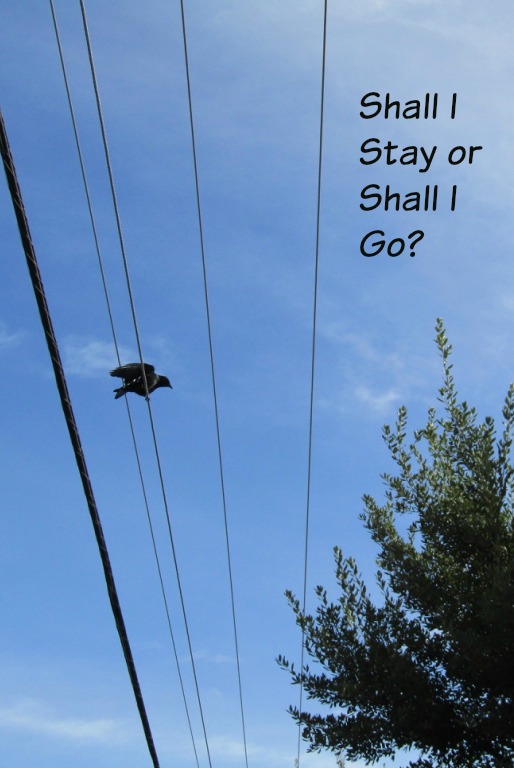
Watching a Crow Decide Whether to Stay or Fly Away

I Found the Crow First on a Power Line


I'm trying to get back to walking again to get stronger, so after I got attached to my Holter monitor this morning I walked all over Posada Lane and behind MedWorks to a drainage ditch. I took almost 300 photos, some of which you will see in future posts. But today I will show you the crow I followed. I first saw it when I had walked over to Las Tablas Road toward the hospital to get a shot of where they are rebuilding a medical complex that burned down a year or two ago. Then I heard some cawing and looked up.  That's when I saw it.


Watching a Crow Decide Whether to Stay or Fly Away
Crow on a Power Line. Will it Fly Away? © B. Radisavljevic


It appeared that the crow couldn't decide whether or not to fly to the tree. Eventually it made a decision and flew away. That was almost the end of the story. Until I walked back around the corner to Posada Lane.

My First Introduction to Crows


I've seen crows around all my life, but I first learned a bit about what they were like when I read Blacky the Crow by Thornton Burgess.  I highly recommend the Burgess animal stories for getting children acquainted with nature in a fun way.


I Find the Crow Again

I was almost back to where my car was parked when I stopped to take this photo. I had never noticed this tree before. The color resembled a sycamore at this time of year, but the leaves were wrong. A woman walked by, saw me with a camera, and asked me if I were taking a picture of the hawk. I told her I was taking a picture of the tree and was trying to figure out what it was. She said, "It's an oak." I knew the leaves were the right shape, but I'd never seen oak leaves so big. 

Watching a Crow Decide Whether to Stay or Fly Away: Photos from a Nature Walk
Red Oak, © B. Radisavljevic

This is my go-to book when trying to identify my local trees in San Luis Obispo County. It's written by a professor at Cal Poly.


There are some cheaper copies at eBay if you prefer that to Amazon.


As I found out later, she was right about the tree, but wrong about the "hawk." It turned out to be my elusive crow, or its friend. There were two of them. This is the one that stayed in one place long enough for me to get a shot. 

Watching a Crow Decide Whether to Stay or Fly Away: Photos from a Nature Walk


Another crow began to circle and call and it flew to the next tree. Finally this bird decided to follow. 

Watching a Crow Decide Whether to Stay or Fly Away: Photos from a Nature Walk
Crow in Flight, © B. Radisavljevic


I think being among the birds and the trees had a healing effect today. How often do you take nature walks?
Watching a Crow Decide Whether to Stay or Fly Away: Photos from a Nature Walk


What is your favorite way to interact with nature?

*****


Monday, October 23, 2017

What I Observed from my Bench at Larry Moore Park

You Can See a Lot of Nature Just Sitting on a Park Bench


Many times we don't really notice what's right in front of us. When I was escaping my roofers' noises this week I found myself on this bench. I'm so blessed I can walk over here, though I didn't on this particular day. This is the bench upon which I sat.


This bench faces west toward the Salinas River, but the riverbed is dry now. On the other side of the river runs some railroad tracks and on the other side of those the 101 Freeway as it goes through Paso Robles. To the left of the bench is the end of the cul-de-sac and a fence dividing public land from the small farm across from it. That land is where I saw the goats after I left this bench to go home.


This Bench Offers a Dose of Wilderness Close to Civilization


One of the first things I saw was an Amtrak train heading south from the Paso Robles Station. It always passes the park, and you can almost set your clock by it if you pay attention. Normally I see it going toward the station, but I was earlier than usual on this day.


You can see beyond the train to the cars on the freeway. It's a divided freeway on this stretch. I was using a zoom lens, so that train and the freeway look much closer than they really are. You'd have to walk about two blocks through the park and across the riverbed and then a bit further to get to those train tracks. When you listen to the video you will hear the traffic, but I believe the train was gone by the time I made the video.

The Salinas River Trail


My bench sits near an entrance to the Salinas River Trail that goes through the park and past it for a couple of miles. If you look to the right of the bench, as I did to take this photo, you will see the trail. Quite often people are walking or biking there. Many people use the trail or the dry riverbed to walk their dogs.


The Video


As I sat on my bench, I made a video by pointing the camera from the right to the left to take in my view. I aimed it up, down, and sideways to take in the height of the tree near me. I narrate to tell you what I'm seeing and doing. I hope you enjoy it.


Still Views from My Bench


Below you see the path that leads to the riverbed, now dry. On the far right is the tree branch you saw in the video that bends all the way to the ground and looks like a little tree by itself. Between that and the path to the river you see a bed of poison oak with a red tinge. The oak is on the left and its branch extends all the way to the ground on the right. The path is steeper than it looks and one has to be careful not to slip -- especially when it's wet after one of our rare rains.


Here's a closer look at that poison oak beside the path to the river.


Here's the other side of the oak on the left side of the path.


Below is the rest of the oak and the rocks near the trail entrance near the road. On the far left you are seeing outside the park onto the private property where I saw the goats yesterday.


This is another perspective of the oak with a zoom and some dried poison hemlock stalks. Have you noticed how much poison lurks near the trails?

Here's a book that will help you identify and deal with poison oak if you happen to touch it. This book has the highest reviews of any I saw, and a great section on identifying these plants.


Below I put the poison oak right next to the oak branch so you can see the leaves clearly. There's part of a willow tree on the far left near the top.


Now You've Shared my Views from the Park Bench


Which did you like best? Did you learn anything from these photos? I feel very fortunate to be able to walk to this park when I need a dose of nature. 

*****

Tuesday, May 16, 2017

I Do Love Trees -- Especially These Trees

These Trees Frame Most of My Sunset Photos

The oak lives right across the street from me. The palms live across the intersecting street from the oak. From my yard, I can frame the sunset between them. My only frustration when photographing the sunset in this frame of trees is the streetlight in front of the oak. 

I Do Love Trees -- Especially These Trees


It's a bit darker in this photo. As often happens, in order to get the sunset shot I want, part of the oak gets cut out. 

I Do Love Trees -- Especially These Trees


Sometimes the oak solos in the photos.

I Do Love Trees -- Especially These Trees


Sometimes the palms stand alone. 

I Do Love Trees -- Especially These Trees


I Think God Made Trees to Complement Sunsets

Of course, there are many other reasons I love trees. They provide shade in summer, turn carbon dioxide into oxygen, provide tasty fruits to eat, and turn lovely colors in the fall. In winter blooming trees provide beautiful reminders that spring is coming soon. They provide places for birds to nest and perch. What's not to love about trees? 

Okay, I do know they drop unwanted seeds in the fall (but the squirrels and birds love them.) Sometimes they drop messy fruits. Raking those lovely colored leaves in autumn is a tradition I like much better than those horrible noisy blowers too many people use now, but I understand that some people consider raking or blowing leaves a chore. I personally think the pros of growing trees far outweighs the cons. Our lives would be much poorer without them. 

I Do Love Trees -- Especially These Trees
 

What do you love most about trees? Which trees do you like best? Do you have a favorite tree that means something special to you? Please share your thoughts in the comments. 

***

Sunday, March 13, 2016

Trees Are Leafing Out Again

Although it's not yet officially spring, the trees are leafing out again. Perhaps it's to respond to all the rain that is refreshing their roots. It seems just last week most trees were still bare, except for the flowering trees. After they shed their blossoms, they started wearing leaves.


Trees Are Leafing Out Again


I took a photo of the birch tree in my side yard that was naked just a few days ago. Now it's dressed in green. I actually think it's more interesting without the leaves. I love its delicate frame of branches.


Trees Are Leafing Out Again

After photographing the birch tree, I turned my attention to the oak across the street. Unlike the photo of the same tree in the top corner, I did not apply any effects to these photos. You will notice how blue the sky is in the photo above as I was looking east. In the photos  below, I was looking north, and the sky was still cloudy gray, yet I took the photos within minutes of each other.

Trees Are Leafing Out Again

As you can see, it was a gray day, even though the rain was past. I could not fit all of my neighbor's large oak tree into the photo because of where the sun was. That's a lamp post sticking up on the right side.

Trees Are Leafing Out Again

The photo above shows the delicate leaves contrasting with the sturdy frame of the oak. Below we see the smaller branches at the very top.

Trees Are Leafing Out Again


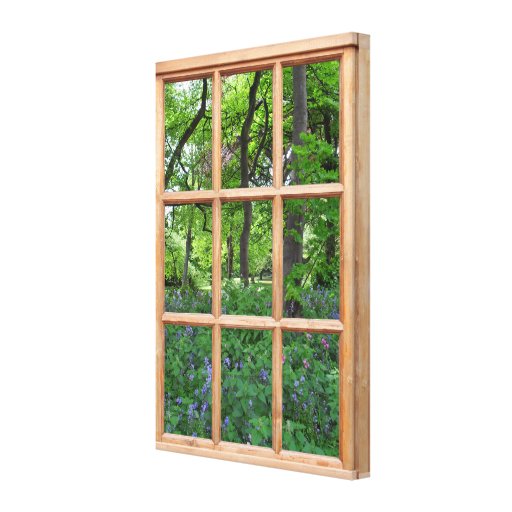
Fairytale Garden 3D Effect Window View Picture Canvas PrintFairytale Garden 3D Effect Window View Picture Canvas Print


Bring a spring window view of trees right into your home with this 3-D canvas wrapped print. It looks like a real window on your wall. Great for a small room with no windows. Is it still looking like winter where you live? Bring a spring window view of trees right into your home with this 3-D canvas wrapped print. It looks like a real window on your wall. Great for a small room with no windows.


Related articles

Thursday, January 28, 2016

Looking at Deciduous Oak Trees in Winter

Looking at Deciduous Oak Trees in Winter
Bare Oak at Berry Hill Farm in Winter
 © B. Radisavljevic

Oak trees are magnificent during all seasons. Some, like the live oaks, are evergreen. Many oaks on the California Central Coast, though, are deciduous. They lose their leaves in winter. That's when I think they are most interesting. With the leaves gone, the oaks reveal their skeletons, their branches that are covered with leaves half the year. It's also easier to see lichens and galls once the leaves don't cover them. That's why in this post we will be looking at deciduous oak trees in winter

The oak  to the right was photographed at Berry Hill Farm on Linne Road in Paso Robles, in January.  Most of the leaves have dropped off. You can see the silhouette of the tree's skeleton. You can click most photos on this page to enlarge them.

Here are more photos that reveal the "bare bones' of the oak trees.

Looking at Deciduous Oak Trees in Winter
Bare Oak in Paso Robles in Winter, © B. Radisavljevic


Looking at Deciduous Oak Trees in Winter
Cattle Grazing near  Oaks in Paso Robles in Winter, © B. Radisavljevic


Looking at Deciduous Oak Trees in Winter
Wide Bare Oak in Paso Robles in Winter, © B. Radisavljevic


Some of the most interesting oak trees are those that have been damaged in some way. Sometimes they've had their shapes changed by man when  they get too close power lines along the  sides of roads. In other instances they've been damaged by fire or lightning. Insects and fungus can also attack oaks. If you see a ring of mushrooms around an oak, it's an indication the tree may be infected in the roots and bark, as well. Oak root fungus can eventually kill an oak tree if the tree has also  been weakened in some other way.

I am not sure what has damaged the tree below.  The mistletoe has probably weakened it, especially since the drought has stressed the trees and made them more susceptible to mistletoe's stealing of nutrients.  Mistletoe can  eventually cause the limb to break at the point where it is attached. 

Looking at Deciduous Oak Trees in Winter
This photo shows an overview of the damaged oak tree. You can see the mistletoe at the top.  © B. Radisavljevic

Looking at Deciduous Oak Trees in Winter
This photo shows the damaged part closer up. You can see the holes that indicate the tree is probably hollow and animals or birds may live within it© B. Radisavljevic

With a tree's leaves gone, it's easier to see unusual growths on the oaks. Two of the most common are lichens and oak galls. The round galls are made by gall wasps laying eggs. The lichens add color to the bark. Neither growth harms the trees, but they do add interest. The galls almost look like the balls one would hang on a Christmas tree, except they aren't shiny.

Looking at Deciduous Oak Trees in Winter
Bird on Branch of Oak in Winter. Notice the round galls, © B. Radisavljevic

Looking at Deciduous Oak Trees in Winter
  Notice the round galls on this oak. © B. Radisavljevic

Looking at Deciduous Oak Trees in Winter
Did you notice the yellowish lichen on the small branches on the left and the lone acorn on the right? © B. Radisavljevic


It ought to be obvious now that I love oak trees, especially in winter. That's why I made a few designs at Zazzle using some of my photos. Most of the oaks I used in Zazzle products were photographed when they still had leaves, but these were taken when the leaves were gone.

Related Posts Plugin for WordPress, Blogger...