Showing posts with label mistletoe. Show all posts

Wednesday, March 16, 2016

The Mistletoe is Bright Green

The Mistletoe is Bright Green

Mistletoe at its Brightest


While I was on the corner of Seventh and Pine Streets yesterday, I could not help but notice that the mistletoe on this tree is bright green in contrast to the new leaves on the tree. Mistletoe loves moisture, and I'm sure the recent rains have made it happy. It's good the trees are also strengthened by the rains. 

Mistletoe is a parasitic shrub. It gets its food and water from the host tree. When mistletoe becomes very dense, it can kill the branch of the tree it's clinging to. This can seriously weaken the host tree. The photo below offers you a closer look at the mistletoe plants. 


The Mistletoe is Bright Green
A Close Look at Mistletoe in March after the Rains


Thursday, January 28, 2016

Looking at Deciduous Oak Trees in Winter

Looking at Deciduous Oak Trees in Winter
Bare Oak at Berry Hill Farm in Winter
 © B. Radisavljevic

Oak trees are magnificent during all seasons. Some, like the live oaks, are evergreen. Many oaks on the California Central Coast, though, are deciduous. They lose their leaves in winter. That's when I think they are most interesting. With the leaves gone, the oaks reveal their skeletons, their branches that are covered with leaves half the year. It's also easier to see lichens and galls once the leaves don't cover them. That's why in this post we will be looking at deciduous oak trees in winter. 

The oak  to the right was photographed at Berry Hill Farm on Linne Road in Paso Robles, in January.  Most of the leaves have dropped off. You can see the silhouette of the tree's skeleton. You can click most photos on this page to enlarge them.

Here are more photos that reveal the "bare bones' of the oak trees.

Looking at Deciduous Oak Trees in Winter
Bare Oak in Paso Robles in Winter, © B. Radisavljevic


Looking at Deciduous Oak Trees in Winter
Cattle Grazing near  Oaks in Paso Robles in Winter, © B. Radisavljevic


Looking at Deciduous Oak Trees in Winter
Wide Bare Oak in Paso Robles in Winter, © B. Radisavljevic


Some of the most interesting oak trees are those that have been damaged in some way. Sometimes they've had their shapes changed by man when  they get too close power lines along the  sides of roads. In other instances they've been damaged by fire or lightning. Insects and fungus can also attack oaks. If you see a ring of mushrooms around an oak, it's an indication the tree may be infected in the roots and bark, as well. Oak root fungus can eventually kill an oak tree if the tree has also  been weakened in some other way.

I am not sure what has damaged the tree below.  The mistletoe has probably weakened it, especially since the drought has stressed the trees and made them more susceptible to mistletoe's stealing of nutrients.  Mistletoe can  eventually cause the limb to break at the point where it is attached. 

Looking at Deciduous Oak Trees in Winter
This photo shows an overview of the damaged oak tree. You can see the mistletoe at the top.  © B. Radisavljevic

Looking at Deciduous Oak Trees in Winter
This photo shows the damaged part closer up. You can see the holes that indicate the tree is probably hollow and animals or birds may live within it. © B. Radisavljevic

With a tree's leaves gone, it's easier to see unusual growths on the oaks. Two of the most common are lichens and oak galls. The round galls are made by gall wasps laying eggs. The lichens add color to the bark. Neither growth harms the trees, but they do add interest. The galls almost look like the balls one would hang on a Christmas tree, except they aren't shiny.

Looking at Deciduous Oak Trees in Winter
Bird on Branch of Oak in Winter. Notice the round galls, © B. Radisavljevic

Looking at Deciduous Oak Trees in Winter
  Notice the round galls on this oak. © B. Radisavljevic

Looking at Deciduous Oak Trees in Winter
Did you notice the yellowish lichen on the small branches on the left and the lone acorn on the right? © B. Radisavljevic


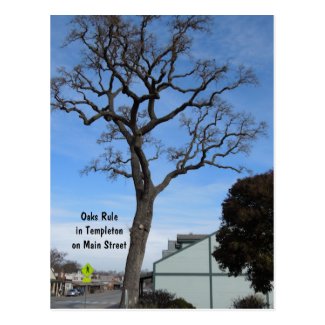
It ought to be obvious now that I love oak trees, especially in winter. That's why I made a few designs at Zazzle using some of my photos. Most of the oaks I used in Zazzle products were photographed when they still had leaves, but these were taken when the leaves were gone.

Saturday, October 17, 2015

A Spooky Cottonwood Tree in the Park

Spooky Dying Cottonwood Tree, © B. Radisavljevic
I usually never have time to take a walk before late afternoon when there are shadows and the sky can be getting darker. This is especially true on cloudy days such as October 14, when I took these photos of the old cottonwood tree at Larry Moore Park. It's a dying tree and is already beginning to look a bit spooky.

One Live Branch Left on  Cottonwood Tree, © B. Radisavljevic
One Live Branch Left on  Cottonwood Tree, © B. Radisavljevic
This second photo shows more of the tree. I focused here on the one living branch that is still green. Most of the mistletoe on this tree is even dead or dying. A bit more of this tree dies every year. I will miss it when it's finally gone.

Friday, July 31, 2015

Trees and Spanish Moss Just Go Together in the North County

Spanish Moss in Templeton


Before I moved to San Luis Obispo County, I thought long strands of Spanish moss could only be found in the South. I was wrong. When I moved to Templeton, it seemed that Spanish moss was decorating most of the trees I saw. It is especially prevalent in old and shady oak forests. But it's certainly not limited to forests.

Trees and Spanish Moss Just Go Together in the North County
Spanish Moss on Oak, © B. Radisavljevic


The moss is also often seen in orchards -- especially old orchards. You can see it here in my very old almond tree. Spanish moss can usually be found in the neglected orchards remaining from the days when Paso Robles was a major almond grower. These orchards are usually found on back roads and on hilltops around the city.


Trees and Spanish Moss Just Go Together in the North County
Spanish Moss on Almond Tree, © B. Radisavljevic


Although Spanish moss is often found on trees that seem to be dying, the moss itself does not hurt host trees. It does not steal any of its nourishment or water. Where there is a heavy growth of moss, it does sometimes shade the lower branches and prevent light from reaching them, but in a forest, other trees will do the same thing. You will sometimes find mistletoe right beside Spanish moss. The mistletoe is detrimental to a tree's health.


Spanish Moss and Mistletoe Together on Oak Trees , © B. Radisavljevic


This photo shows one of the longest strands of Spanish moss I've seen on any of my trees. I was trying to interest my neighbor's cat in playing with it, but since I wanted her to, she wouldn't.

I should consider myself lucky to have so much Spanish moss around. If I want to use if for mulch or in planters, I don't have to buy it. If anyone does want to buy it, Amazon has packaged Spanish moss for sale


Trees and Spanish Moss Just Go Together in the North County
A Rope of Spanish Moss, © B. Radisavljevic


Saturday, April 25, 2015

There is Little Life Left in this Old Cottonwood Tree

Cottonwood tree at Larry Moore Park, © B. Radisavljevic
This cottonwood tree has been important to me since I first started walking in Larry Moore Park years ago - at least ten years ago. I have seen teens climb this tree, and, yes, I even saw a small dog climb this tree. But I'm afraid that one day it will share the fate of trees closer to the river and completely die. As you can see, only one section of the tree is still alive -- the bright green section in the center of this photo.

Cottonwood tree at Larry Moore Park, © B. Radisavljevic
In this photo o the right, you can see the one branch that still seems to be healthy and putting forth new shoots. I took this shot from a different position so I could get a closer look at it.

Unfortunately this tree is the victim of drought and mistletoe. The cottonwood trees right next to the river are still fairly healthy because their roots can reach deep and get water. But the mistletoe appears to be sucking all the nutrients from this poor tree. It lost a large branch a couple of years ago in a storm.

Mistletoe on Cottonwood tree at Larry Moore Park, © B. Radisavljevic
This last shot gives you a closer look at the deadly mistletoe at the end of one branch. It's the largest clump, but you can see in the top photo that it's not the only clump. Except for this branch with new leaves, all the rest of the green on the tree is the mistletoe that's killing it.

We have mistletoe on most large trees in our county, and many are also adorned in Spanish moss. Do you have either of these growing on trees where you live?

Thursday, March 26, 2015

Two Cottonwood Trees with Character at Larry Moore Park

Neglected Cottonwood Tree


Larry Moore Park is a wonderful place to see a variety of trees in all states of growth and damage. I personally think the damaged ones are more interesting.


Their suffering at the hands of wind, storm, and lightening have given them character that distinguishes them from the other trees in the park. Often the trees are just skeletons and the only green thing about them is the mistletoe that feeds on them.  Such is the tree in the photo here, which was taken in winter about four years ago. Except for all that mistletoe, it was still pretty much intact.


Above is that same tree on March 4 last year, from the other side. You can see its broken branch, much of it still on the ground. It gets worse and worse every year. No one seems to care. The trees closer to the river are just left to disintegrate when they fall,  but they are a bit better at hauling off parts of this tree a few months after the branches break off. Maybe that's because it's in the middle of the park near the trail. Even the vandalized picnic bench has not been fixed in over a year.


Another Cottonwood in the Park


Today I shot this picture of a cottonwood tree near the other end of the park. It's actually not in the park itself, but on private property next to the park on the cul-de-sac.  It is beginning to leaf out with new growth, but you can see it's also been reshaped a bit by nature. It is very close to the south entrance of the park at the end of Riverbank.
Related Posts Plugin for WordPress, Blogger...